
Most people think posture is just about sitting up straight.
But what if your breathing habits were quietly driving your posture—and your pain?
Emerging research shows that how you breathe directly influences your spine, core stability, and even balance.
The Hidden Link Between Breathing and Posture
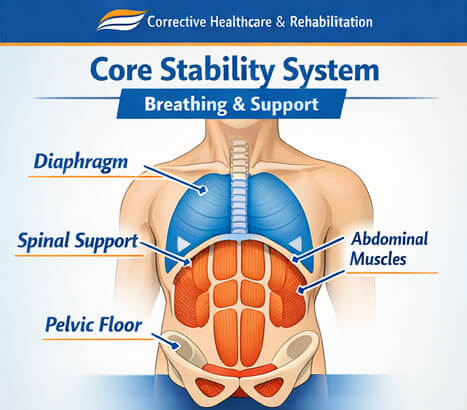 Your diaphragm isn’t just a breathing muscle, it’s also a core stabilizer.
- Works with abdominal and spinal muscles
- Helps regulate intra-abdominal pressure
- Supports spinal alignment

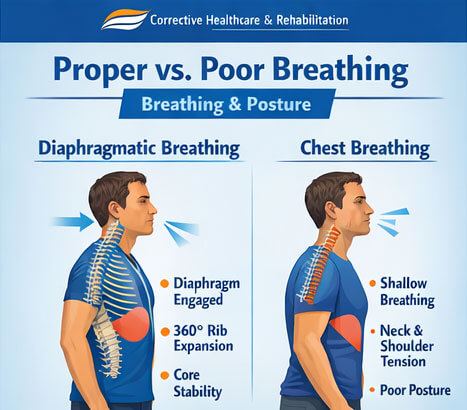 What Happens When You Breathe Poorly
- Reduced spinal stability
- Increased neck and shoulder tension
- Worsening forward head posture
- Increased fatigue and discomfort
The Posture-Breathing Cycle
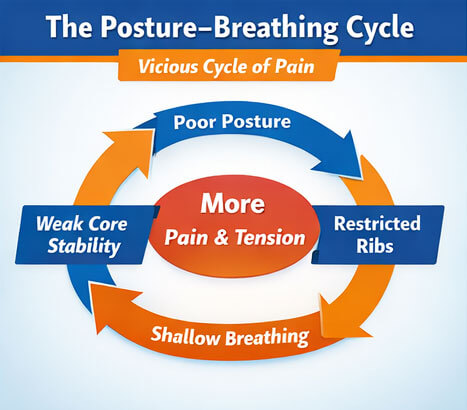 Poor posture → rib restriction → shallow breathing → reduced core stability → more pain → worse posture
Signs Your Breathing May Be Affecting You
- Neck/shoulder tightness
- Shallow breathing
- Rib stiffness
- Low back discomfort
What Proper Breathing Looks Like
- Quiet, controlled breathing
- 360° rib expansion
- Minimal neck/shoulder involvement
A Simple Way to Check Your Own Pattern
Try this: place one hand on your chest and one on your belly. Take a normal breath. Which hand moves first, and most? If it’s the chest hand, you’re likely a chest breather. This isn’t a diagnosis, just a useful thing to notice. Practicing slow, belly-first breaths for even a few minutes per day can help retrain the pattern over time.
Making It Part of Your Care
At Corrective Healthcare & Rehabilitation, we assess:
- Breathing patterns
- Posture
- Movement quality
- Muscle imbalances
If you think it’s just one exercise that will fix everything, you’re likely missing the bigger picture. Book an assessment to address the root cause, not just the symptoms.